Freeman Explore

  • Buy our Books!
  • A Year in the Wilderness
    • Bear Witness (Short Film)
    • Read the Book!
  • About
    • Videos
    • Media Resources
    • Media Archives
  • Education
  • Speaking
    • Speaking Resume
    • Testimonials
  • Expeditions

Descending the Rio Roosevelt’s last rapids

The dull roar of powerful rapids have been a constant reminder of the power of the Rio Roosevelt over the past 3 days. We have been camping in the forest and spending more time walking forest trails rather than our normal rythm of paddling all day. We spent two days walking back and forth on forest trails scouting the river and walking to a farm 10 km from the beginning of the rapids to gain more information about the rapids.
We decided that the safest options was to portage our 5 canoes and mountain of equipment 3 km along good trails to the base of the first rapids. Paul and I spent 5 hours hauling 4 of the canoes and several packs to the beach below the rapids last night during the relative cool night air. We crashed in our hammocks for a few hours and then the whole group began portaging the rest of the supples at dawn. By 9:30 Eurico dropped the last pack on the beach and Hercilio prepared a big feast. Our next portage lay only a kilometer away and we needed to regain our strength.

The swift current quickly swept us to the next rapids. We snaked along the shore wading next to the canoes and using ropes to carefully maneuver the canoes past the surging rapids. Twice we have to unload the canoes and carry all of our equipment and canoes over the rocks. After several hours of hard, wet work we launched the canoes at the base of the rapids. Smaller rapids were scattered over the next 5 km. We wove through islands and plunged over ledges and through crashing waves. – After a long day we stopped on a small beach just above Sumauma, the largest of the rapids. Sumauma is our last major obstacle before we reach the mouth of the Rio Roosevelt. One hundred years ago Roosevelt’s crew spent a day and a half navigating this final stretch of rapids. With any luck we will also be past the last rapids by lunch time tomorrow and we will reach the mouth of the Rio Roosevelt tomorrow afternoon.
Filed Under: Rio Roosevelt Centennial Expedition Tagged With: mouth, rapids, Rio Roosevelt, river mouth

A long stretch of rapids

Everyone is doing well. We have just begun a long, 15 km stretch of rapids. This involves a lot of portaging and some paddling. I’ll have a bigger update for you when we reach the end of the rapids– and the mouth of the Rio Roosevelt.

Filed Under: Rio Roosevelt Centennial Expedition

Going with the flow

The Rio Roosevelt continues to offer plenty of surprises and the distance we travel each day seems to be tied as much to the people we meet through chance encounters. Yesterday we paddled 46 KM and camped 100 meters up a small river at a beautiful campsite in the jungle. Paul and I paddled up the little river for several miles. The river and surrounding forest was full of life.

We heard a large group of White Lipped Peckeries in the forest and krept into the jungle to look for them. Soon over 100 of these wild pigs with tusks began streaming past us. Occasionally one would look in our direction but if they were aware of our presence they remained undisturbed. Monkeys ran through the tree tops over our tents and in the middle of the night the loud crack of a large caiman’s tail slapping the water woke us with a start.image

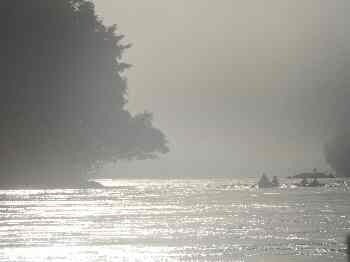
This morning Paul and I left our camp early and slowly floated down the river. We uploaded photos and text to the Wilderness Classroom. (Satellite reception is better in the middle of the river than under the dense canopy of the rainforest.) A dense fog blanketed the river, but soon the sun’s powerful rays won out and the heat of the day set in.

After a few hours of paddling we spotted our first farm in several days. We pulled over to ask about the large rapids ahead. We decided to cook a large fish that Jack caught this morning and we are resting on a large shaded porch a the edge of the river. It is a beautiful place and I suspect that we will spend the rest of the day here. On the river you have to go with the flow.

Filed Under: Rio Roosevelt Centennial Expedition Tagged With: animals, Caiman, flow, peccary

The Rio Roosevelt is filled with surprises

After pulling off the river early to escape the heat of the day, we stopped at an old farmstead. Here we were greeted warmly by its sole inhabitant, Jose, and settled in for the day. When Jose commented that this old farmstead was the only one on this stretch of river, we checked our GPS. Much to our surprise, it confirmed that our latitude matched that of the farmstead where Rondon & Roosevelt had camped 100 years before. We had stumbled upon historic ground!

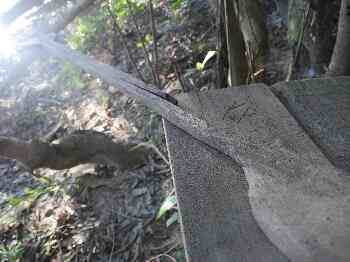
As we marveled at this discovery, Tonico heightened the intrigue by commenting that he’d noticed an old table tucked in the brush by the riverside with initials carved in it that matched those of Theodore Roosevelt’s son, Kermit, who accompanied him on the 1914 expedition. We raced down to check. Sure enough, “KR” was clearly etched in the tabletop. Adding to the fun was an ancient hand-carved canoe paddle we found partially buried in the riverbank near the table. Left behind by Roosevelt’s team? No, it turns out Tonico scratched the initials in the table as a good-natured prank.

The mysterious paddle and table with KR scratched in by Tonico.

The mysterious paddle and table with KR scratched in by Tonico.

To make up for the day we spent in the forest and to escape the heat we loaded our canoes at 10 pm on Friday night and spent 10 hours floating and paddling 55 km. At dawn we reached the Inferno Rapids and, like Roosevelt, we hired some locals from the remote fishing camp at the base of the rapids to help us around the 3 meter falls and smaller rapids just downstream.20140608150818

We are camped at the base of a beautiful rapids about 3 miles below the Inferno Rapids. We are enjoying our first rest day since we started paddling 10 days ago. Shade trees are sprinkled around the beach, making it a perfect place to rest and recharge.

We have about 100 miles left to go before we reach the mouth of the Rio Roosevelt. Our last major obstacle is a 10-mile stretch of rapids 60 miles downstream. People have been telling us about the large rapids near the end for a long time. Soon we will experience them for ourselves. Roosevelt took 2 days to navigate the rapids. I hope we will be able to navigate them quickly as well. The Roosevelt has become a large and powerful river now. The Inferno Rapids was a real eye-opener. It is hard to comprehend that the water was 20 feet higher two months ago, but the dried aquatic plants on the rocks makes it clear how high the water routinely gets during the rainy season.

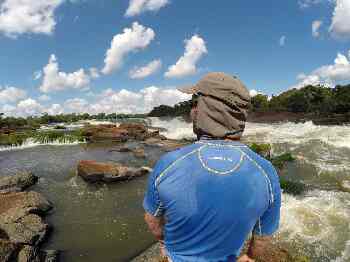
Dave stands below Inferno Rapids.

Dave stands below Inferno Rapids.

Filed Under: Rio Roosevelt Centennial Expedition, Uncategorized Tagged With: Inferno Rapids, Kermit Roosevelt, paddle, Theodore Roosevelt

Locals gave us a hand around dangerous rapids

Last night we fell asleep to the rumble of the Panelas Rapids. In the morning our first job was to figure out a way around the half mile long, dangerous rapids. Roosevelt found a local man to guide his party safely past the rapids and we did the same thing. Several locals led us down a narrow side channel and helped us portage our canoes and equipment around the worst of the rapids. It took us about an hour to carry everything around.

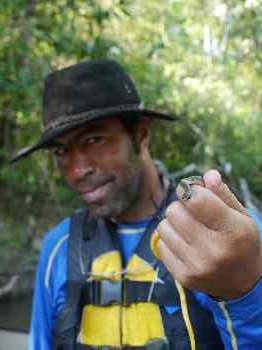
Hercilio holds a small snake that likes to live in the trees.

Hercilio holds a small snake that likes to live in the trees.

We paddled on for the rest of the day and only encountered a couple sections of fast water. Our next major rapids is 40 miles downstream.

Jack and Hercilio caught 3 large piranha just before dark in the exact place we were all bathing a few hours before. It makes you think twice about swimming. However, it is really hot, and piranha bites are very rare. I think our chances of getting a fungal infection or a painful rash from poor hygiene are far greater than being bitten by a piranha.

Filed Under: Rio Roosevelt Centennial Expedition Tagged With: Piranha, rapids, Roosevelt, snake

Meet our new fine-feathered team member

We camped at a vacant riverside farm. Lovely place. The Rio Roosevelt wraps arounds an island here with rapids and big rock outcroppings on both sides. Hot day so were in and out of the water, frolicking in the swift current. The same pools produced our dinner — grilled pirahna laced with sliced lemon, compliments of s tree where we pitched our tents.image

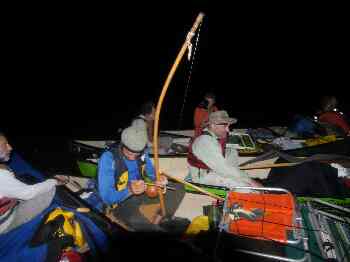
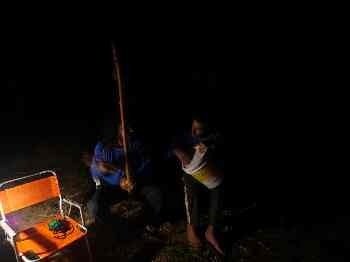
Over dinner we celebrated Ercilio’s 48th birthday. A fun-loving guy full of good cheer and playful antics, he’s also a fine chef and with his friend Jacinto looks after the camp kitchen. After his birthday dinner he entertained us with his “berimbau,” a long single-stringed instrument that resonates through a gourd. It is played with a stick and a stone, and produces a grand total of two notes. But we managed to share hours of American and Brazilian folk songs to the beat of that odd instrument.image
Our paddle today took us through a large braided rapids. Running it proved a challenge for a few of our crew and we got separated amongst the braids. We awaited their arrival at a native farmstead below the rapids. The family offered us a basket of lemons and a rooster so we bought them with plans for a lemon chicken dinner. But when we continued our paddle the rooster perched himself on the stern of a canoe like a cackling stevadore and quickly became a source of team entertainment. He even gained a name: Salvador. You will be pleased to know that he’s now our official expedition mascot and is not destined for the cookpot.

image
Tonight we’re camped at a tiny native settlement above a mile-long stretch of roaring rapids. Our tents are set in a yard alongside the general store. Villagers come & go through the evening buying supplies or playing snooker on the veranda pool table. The kids are intrigued with our ipads and sat phone equipment. And Salvador is being challenged by the resident rooster. So we’ve found him a perch high above the chickens and guinea pigs scurrying about the grounds. Our team is enjoying a round of cold beers after a day in the scorching equatorial sun. Concerns about how we’ll negotiate this long stretch of rapids will have to wait till morning.

Filed Under: Rio Roosevelt Centennial Expedition Tagged With: mascot, rapids, Rooster

Paddling our first rapids on the Rio Roosevelt

Today we paddled around a bend in the Rio Branco and the Rio Roosevelt came into view. Everyone howled with joy. After over a week of stops and starts and even flying over the Rio Roosevelt we were finally descending the river that President Theodore Roosevelt’s party explored 100 years ago. One of our goals is to see how the river has changed over the last 100 years. Is it still the wild and remote place that Roosevelt encountered?

Yesterday we encountered rubber tappers, just as Roosevelt did in 1914. We have encountered a few farms in the region, but large tracks of land remain wild and undeveloped. In fact, we recently learned that anthropologists discovered an uncontacted tribe living near the Rio Branco several months ago. The Brazilian government is setting up a reserve similar to the Cinta Larga reserve so that the uncontacted tribe will remain undisturbed and can continue to live as they have for centuries. Those people were probably living in this region when Roosevelt traveled through.

image

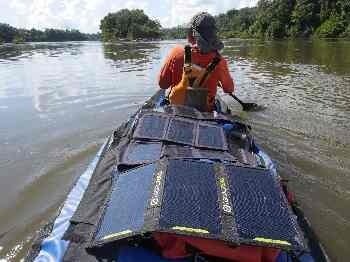
Goal Zero solar panels supply all the power we need to charge our electronic devices.

The Rio Roosevelt is a grand river, with rocky islands and numerous rapids. This afternoon we navigated 3 rapids. All of the rapids were small enough that we were able to descend them safely in our canoes and did not have to portage. We are camped at the base of the last rapids. I am listening to the dull rumble of the rapids and watching the sun dip below the horizon as I write this. I can see President Roosevelt sitting in this place writing in his journal.

Filed Under: Rio Roosevelt Centennial Expedition Tagged With: canoe, Goal Zero, rapids, Rio Roosevelt, Theodore Roosevelt

Tapir sighting and a warm day

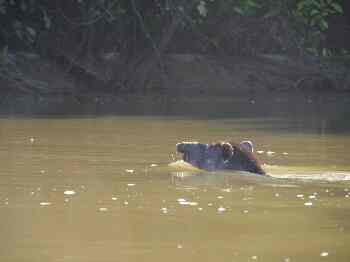
The current began to accelerate and the dull roar of a large rapids was audible 1/4 mile from the falls. We surprised a tapir swimming across the river and got some great photos of it before it scrambled out of the water and disappeared into the thick jungle. We landed on the right side of the river to scout the rapids and found a 10 foot falls that would require a short portage. Paul and I crossed to the left side of the river and found an easy portage. We radioed the rest of the team to tell them about the easy path that we had found, but they decided to stay on the right side of the river and hack a trail through the forest. We quickly unloaded our 4 Sea to Summit 120 liter Hydraulic Dry Bag backpacks and carried them 30 feet across a rock shelf.

20140603132622

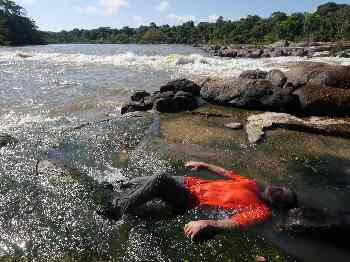
After 5 minutes we had our canoe loaded at the base of the thundering rapids. We sat in the shade and watched the rest of the group complete the portage for about 40 minutes and then they were finished we hopped in our canoe and met up with them so that we could continue down river together. Paul found a nice pool to lie in and let the cool water wash over him for several minutes.

20140603132717

The heat is really intense here and from 10 AM to 3 PM the sun really beats down on us. We stopped early on a large sandbar because we don’t expect to find large sand beaches on the Rio Roosevelt. We are very close to the Roosevelt and with any luck we will reach the Roosevelt early tomorrow morning. Paul and I startled a small caiman shortly before reaching our camp, it darted into the water as soon as we noticed it. The animals are amazing. The biodiversity here is hard imagine. Every day we see new things and I look forward to seeing what awaits us tomorrow.

Filed Under: Rio Roosevelt Centennial Expedition Tagged With: falls, portage, rapids, Sea to Summit, tapir

Wedding ring bee sting

Last night there were a lot of bees at our campsite. They were not aggressive and as long as you let them lick you and didn’t try to swat them, they did not sting. Unfortunately Tonico and I both had bees land on our hands. We must have squished them by accident because we were both stung right by our wedding rings. I took mine off because I was worried my finger would swell. Tonico left his ring on and his finger swelled up like a ballon. After 18 hours it was still very swollen so we convinced him we should cut it off. Paul used hacksaw blade to cut the ring. Don’t worry Celine his finger is fine and he still loves you.

20140601171755

Tonico’s newly shaped wedding ring.

Filed Under: Rio Roosevelt Centennial Expedition Tagged With: bee, bee sting, Tonico, wedding ring

Tambaquis, piranhas and electric eels, oh my!

This morning we pushed off from shore and let the current grab our bulging canoes. The swift current helped us travel 25 miles relatively easily. There were many small rapids, but we were able to navigate them with having to portage. A portage is when you have to carry your canoe and all your supplies around a rapid. We saw many animals today, including howler monkeys and lots of macaws. Hercilio caught a large tambaqui, which is a fruit-eating fish. It has large flat teeth that it uses to crush the seeds that it eats. Paul caught his first piranha. We are going to eat the tambaqui and piranha for dinner!

1401564640242

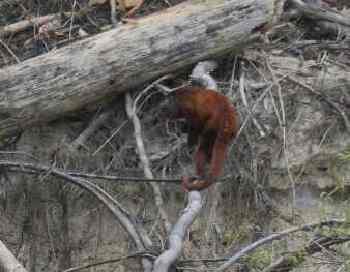
A howler monkey clambers down a branch along the riverbank.

We also paddled past a small Zoro Indian village today. We did not see any people, but we saw a palm thatch hut and a school boat tied to shore. The right side of the river belongs to the Zoro Indians. Eleven percent of Brazil has been set aside as reserves that are controlled by the indigenous people. Most of the indigenous people in the Amazon have regular contact with the outside world and many indigenous people live in towns or cities, have T.V., cars, computers, and other modern conveniences. However, anthropologists estimate that there are about 60 uncontacted tribes still living in the Amazon.
20140531142025

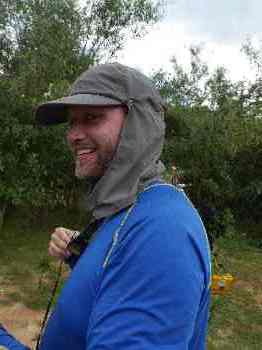
Dave shows off the sun protection provided by his ExOfficio BugsAway Cape Hat.

Brazilian Believe it or not! An electric eel surfaced alongside our canoe today. It is one of the Amazon’s most amazing critters —  It packs a punch and can send a 650-volt electric jolt that kills or stuns the fish it preys on.  That’s 6 times the voltage that powers your house and, as you know, even a shock from house wiring can be deadly.  Fortunately, electric eels don’t  generally choose people as prey.  However, a participant on a canoe expedition down this same river system about 10 years ago reported getting zapped by an eel while swimming.  Apparently, that eel just wanted to say hello because that lucky swimmer noted that the mild zap he got felt “mildly pleasant.”

20140531141916

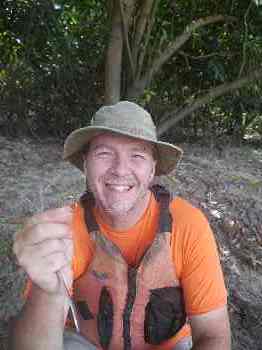
Paul is super comfortable in his MTI Adventurewear Slipstream PFD and ExOfficio SolCool shirt.

Filed Under: Rio Roosevelt Centennial Expedition Tagged With: electric eel, ExOfficio, howler monkey, MTI Adventurewear, Piranha, tambaqui

  • « Previous Page
  • 1
  • …
  • 59
  • 60
  • 61
  • 62
  • 63
  • Next Page »

Contact Us

Do you have questions or comments? Perhaps you would like to join us on a wilderness adventure, or have us speak at your business, school, or event.

Contact us!

Connect with the us

  • Facebook
  • Instagram
  • Twitter
  • Vimeo
image

Copyright 2025 Freemans Explore · Log in

Loading Comments...